A lawyer and linguist during the 18th, Sir William Jones, while stationed in India, observed that the Sanskrit language shared similarities with other European languages. He theorized that Sanskrit shared a common ancestor with Greek, Latin and Old Iranian. There are many words in Indo-European languages that are cognate with one another, i.e. that were inherited or share a common etymological ancestor. For instance the word “father” in English compares to Vater in German, pater in Latin, πατήρ, patêr in Greek, , pitṛ in Sanskrit.1 The podcast The History of English goes through numerous examples of these similarities.2 If you’re a bit of an etymology nerd it is incredibly fascinating. How did these people separated by thousands of miles come to speak similar languages? Since the 18th century linguists, historians, archaeologists, and now geneticists have been attempting to explain the shared linguistic and genetic ancestry of nearly 4 billion people.
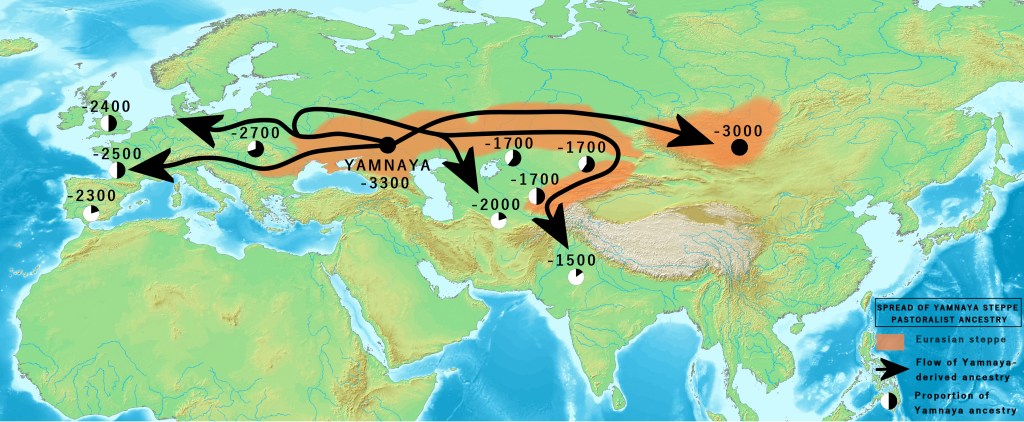
Geneticists have found compelling evidence that sometime around 3000 B.C. a group of people known as the “Yamnaya” migrated from what is now Ukraine and over subsequent generations changed the language and genetic makeup of the people of Europe, the Middle East and parts of Asia. Whether this was always a violent interaction is impossible to know, but genetic evidence shows that indigenous male genes seemingly vanish around the time that these Proto-Yamnaya populations emerge. The indigenous female DNA remained in subsequent generations which certainly suggests some form of conquest by male pioneers of some sort.3
At times the interactions may not have been violent; other research has shown that these Yamnaya people carried remnants of Yersinia pestis “The Plague” DNA. A similar event like that which occurred in the Americas may have occurred. Instead of smallpox, the plague may have arrived and wrecked havoc on a population with little immunity. This could have led to the settlement or inclusion of smaller bands of people after a prehistoric pandemic.
There are so many what ifs and questions surrounding these fascinating people. It is hard to imagine that interactions with these people and their neighbors were not often or sometimes violent. History is full of examples of large migrations and resulting conflicts. Every day it seems ancient DNA and archaeology are shedding new light on this fascinating time of human history.
Source material and places to learn more.
 History Buff Chronicle
Leave a comment